dispensing processes
sealing / bonding / potting / encapsulation / insulation / thermal management
liquid sealing and sealing with
dispensing systems from dosmatix
A barrier and connection in one
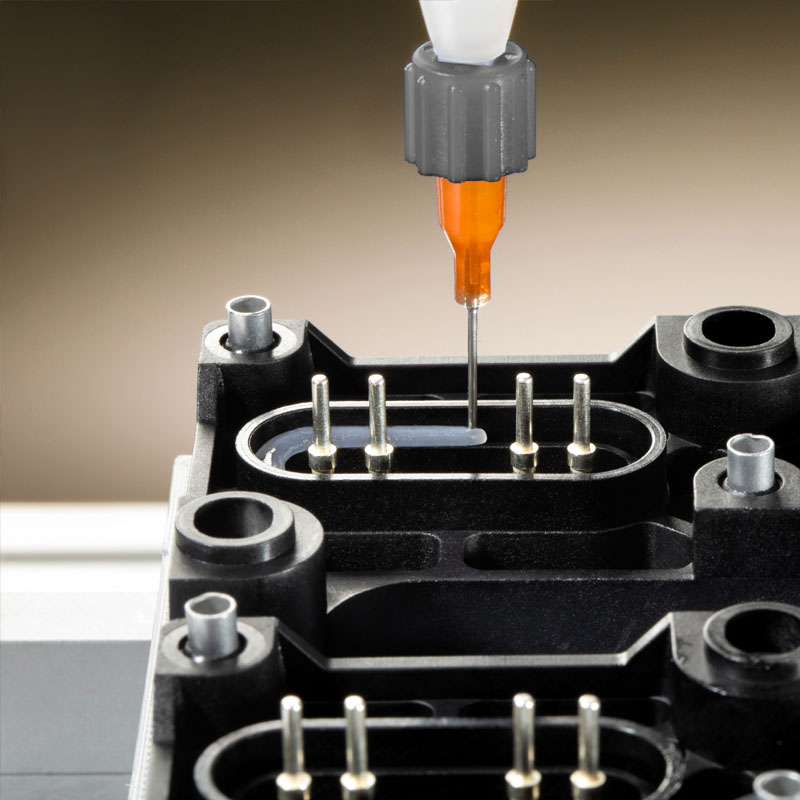
Sealed joints offer protection against external influences such as penetrating moisture, gases, dust, aggressive agents or temperature fluctuations. By applying, or dispensing, a fluid seal in the form of a strip of material, sensitive parts such as control devices or housings can be protected. Application, usually carried out automatically along a previously defined contour, also serves to join components if, for example, an adhesive is also applied.
In sealing, various different dispensing and potting processes are used:
Dam and fill
A thick, highly viscous material strip is placed like a dam around the component. Once it dries, potting resin or thick film paint can be poured into the dammed area.
Formed-in-place gasket (FIPG)av
This is the creation of a connection that cannot be undone. A paste-like strip of sealant is applied to the parts to be sealed which are then linked together and can no longer be separated.
Cured-in-place gasket (CIPG)
Sometimes it is also necessary to create a separable connection. Once the fluid sealant is applied, the cover is joined but can be released again for later repair purposes.
questions and answers

How does liquid sealing work?
A: Liquid sealing is an advanced process in which special sealing materials are applied in liquid form to sensitive electronic components. Our dispensing systems enable precise dosing and placement of the liquid sealant, creating a uniform, stable protective layer. This layer insulates the components, ensuring improved longevity and reliability of the electronics – even under the most demanding conditions.
When should liquid sealing be used??
A: Liquid sealing should be used whenever electronic components need to be protected from harmful environmental influences such as moisture, dust, dirt, or vibrations. It is particularly important in applications where high reliability and long service life of components are required – for example in the automotive industry, medical technology, aerospace, or e-mobility.
How is liquid sealing used in production??
A: Application is carried out using dispensing systems that apply a precise amount of sealant to the components. dosmatix provides advanced dispensing equipment that ensures accurate dosing and even distribution of the sealing material. Liquid sealing is used especially in electronics, automotive, and medical technology manufacturing to guarantee the longevity and reliability of components under extreme conditions.
How does liquid sealing improve product quality?
A: Liquid sealing contributes significantly to improving product quality by forming a reliable protective layer for electronic components. Using precise dispensing systems, dosmatix ensures that the liquid sealant is applied evenly and accurately, enhancing the quality of the final product. A uniform seal prevents the ingress of harmful substances, ensuring that electronic components function reliably even in demanding environments.
Welche Fügeverfahren gibt es?
A: In der Industrie gibt es verschiedene Fügeverfahren, um Materialien miteinander zu verbinden, wie zum Beispiel Schweißen (Lichtbogen-, Widerstands- und Reibschweißen), Löten, Kleben, Nieten, Schrauben und Clinchen. dosmatix bietet Lösungen für eine Vielzahl von Vergussprozessen an, bei denen je nach Anwendungszweck die jeweils geeigneten Materialien zum Einsatz kommen. So werden beispielsweise Materialien zum Dichten, Kleben, Vergießen, Versiegeln, Isolieren oder für das Wärmemanagement verwendet.
contact us
direct contact
sales(at)dosmatix.com
phone: +49 8783 9667 530